Pattern: Routing
Motivation
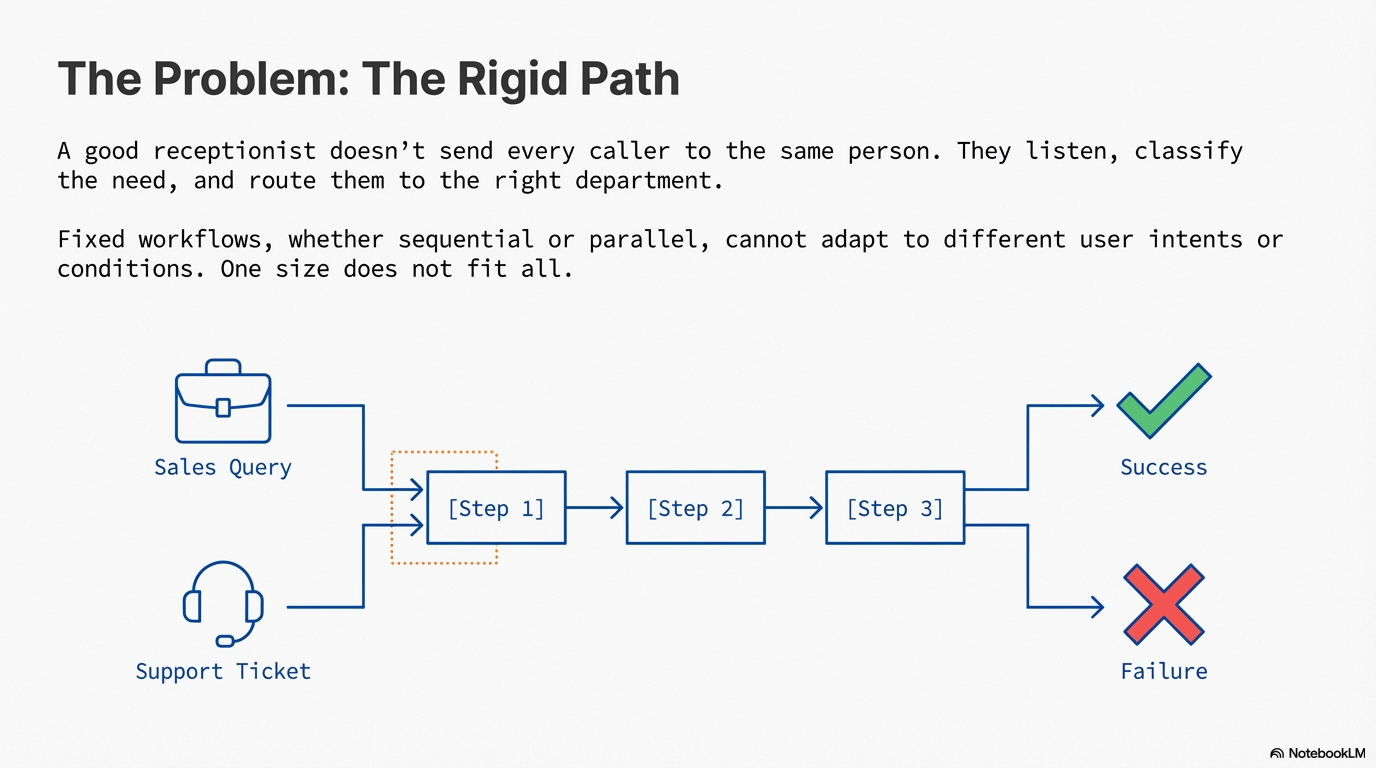
A receptionist listens to each caller and routes them to the right department—sales, support, or billing. A triage nurse assesses patients and directs them to appropriate specialists. We constantly make routing decisions: choosing which tool to use, which person to ask, or which path to take. Routing in agents works the same way: evaluating the situation and directing tasks to the most appropriate handler, tool, or workflow path.
Pattern Overview
Problem
While sequential processing via prompt chaining is foundational for deterministic, linear workflows, real-world agentic systems often need to arbitrate between multiple potential actions. Agents must adapt their behavior based on variable inputs, user intent, system state, or the outcome of previous operations, rather than following a fixed sequence. Without routing, agents remain static executors of predetermined sequences, unable to make context-aware decisions or leverage specialization by directing different tasks to appropriate sub-agents or tools.
Solution
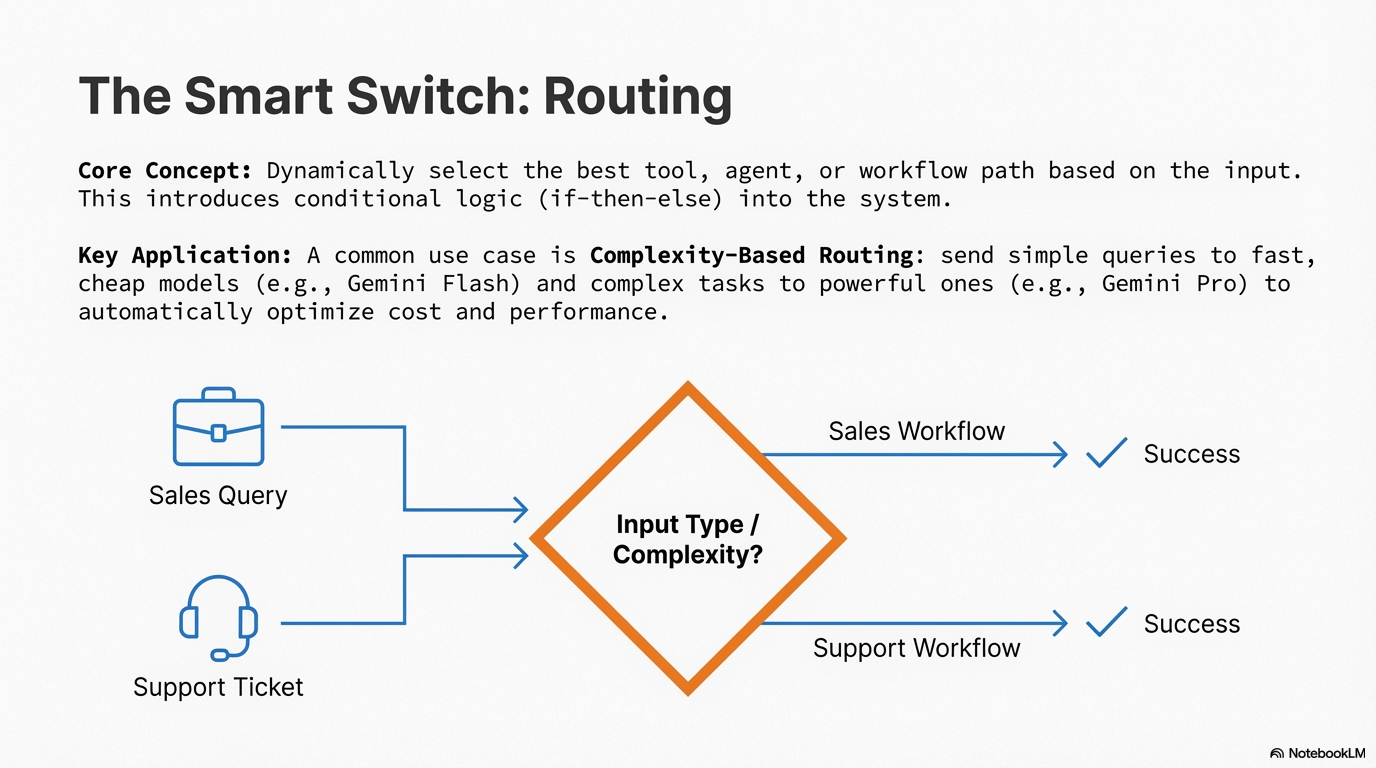
Routing introduces conditional logic that enables agents to dynamically select between multiple potential actions based on input, state, or conditions. The core mechanism involves evaluating specific criteria to select from a set of possible subsequent actions. For instance, a customer service agent might first classify an incoming query to determine user intent, then route it to a specialized agent for question-answering, a database retrieval tool for account information, or an escalation procedure for complex issues—rather than defaulting to a single predetermined response pathway.
Routing can be implemented at multiple junctures within an agent's operational cycle: at the outset to classify a primary task, at intermediate points within a processing chain to determine subsequent actions, or during subroutines to select the most appropriate tool from a given set. This flexibility makes routing essential for building adaptive, context-aware agentic systems that can handle diverse inputs and contexts, transforming agents from static executors into dynamic systems capable of making context-aware decisions and enabling specialization.
Key Concepts
- Dynamic Decision-Making: Routing enables agents to evaluate conditions and make runtime decisions about execution paths, moving beyond fixed sequences.
- Intent Classification: The pattern often begins with classifying user input or system state to determine the appropriate route, enabling specialized handling.
- Conditional Flow Control: Routing introduces if-then-else logic into agent workflows, where different conditions lead to different execution paths.
- Multiple Implementation Methods: Routing can be achieved through LLM-based analysis, embedding similarity, rule-based logic, or trained ML models, each with different trade-offs.
- Complexity-Based Routing: A specialized form of routing that classifies task complexity and routes to appropriate models or tools based on resource constraints, enabling cost-effective optimization by using lightweight models for simple tasks and powerful models for complex ones.
How It Works
Routing operates through a three-step process: evaluation, decision, and delegation. First, the routing mechanism evaluates the input, state, or condition using one of several methods. LLM-based routing uses the language model to analyze input and output a category or identifier. Embedding-based routing converts input to vectors and compares them to route embeddings using semantic similarity. Rule-based routing uses predefined logic (if-else statements) based on keywords or patterns. ML model-based routing employs a trained classifier to make routing decisions.
Based on this evaluation, the router makes a decision about which route to take. Finally, it delegates the task to the appropriate handler—whether that's a specialized agent, a specific tool, or a different workflow path. The chosen route then receives the original input or a transformed version of it, processes the task, and returns results that may feed back into the routing system for subsequent decisions.
When to Use This Pattern
✅ Use this pattern when:
- Multiple specialized handlers exist: You have different agents, tools, or workflows optimized for different types of tasks, and need to direct inputs to the right one.
- User intent varies significantly: User queries or inputs can have fundamentally different intents (e.g., booking vs. information vs. support), requiring different processing paths.
- System state affects behavior: The agent's behavior should change based on current state, previous outcomes, or environmental conditions.
- Tool selection is dynamic: You need to select from multiple available tools based on the task at hand, rather than using a fixed tool sequence.
- Workflow branching is needed: Different inputs or conditions require fundamentally different processing workflows, not just parameter variations.
- Resource optimization is required: You need to route tasks to different models or tools based on complexity, budget, or performance requirements (e.g., simple queries to fast/cheap models, complex tasks to powerful models).
❌ Avoid this pattern when:
- Sequential processing is sufficient: If all inputs follow the same processing steps in the same order, prompt chaining is simpler and more appropriate.
- Routing logic is trivial: If the routing decision can be made with a simple if-else based on a single, easily extractable feature, consider rule-based routing or even hardcoding the logic.
- Latency is critical: Routing adds an extra decision step, which can increase latency. For high-speed, low-latency requirements, consider pre-classification or simpler approaches.
Decision Guidelines
Choose routing when the benefits of specialization and adaptability outweigh the added complexity. Consider the routing method: LLM-based routing offers flexibility but adds latency and cost; embedding-based routing is fast and semantic but requires pre-computed route embeddings; rule-based routing is deterministic and fast but less flexible; ML model-based routing offers good balance but requires training data. The choice depends on your accuracy requirements, latency constraints, and the complexity of the routing decision.
Practical Applications & Use Cases
Routing is essential for building adaptive agentic systems that can handle diverse inputs and contexts. Common applications include intent-based request handling, dynamic tool selection, and multi-agent coordination.
- Customer Service Agents: Route user queries to specialized handlers for orders, products, support, or general information based on intent classification.
- Document Processing Pipelines: Route incoming documents (emails, tickets, forms) to appropriate processing workflows based on content, format, or metadata.
- Multi-Agent Systems: Route tasks to specialized agents (researcher, writer, reviewer) based on task type and current workload.
- AI Coding Assistants: Route code snippets to different tools based on programming language, intent (debug, explain, translate), or complexity.
- Content Classification Systems: Route content to appropriate moderation, analysis, or processing pipelines based on type, topic, or risk level.
- Resource-Aware Model Routing: Route requests to different LLM models based on task complexity, budget constraints, or latency requirements. Simple, common questions are routed to fast, cost-efficient models (e.g., Claude Haiku, Gemini Flash), while complex or unusual questions are routed to more capable models (e.g., Claude Sonnet, Gemini Pro). This enables automatic optimization of cost and performance without manual intervention.
Implementation
Prerequisites:
```bash
pip install langchain langchain-google-genai langgraph
# or
pip install google-adk
```
Basic Example
from langchain_google_genai import ChatGoogleGenerativeAI
from langchain_core.prompts import ChatPromptTemplate
from langchain_core.output_parsers import StrOutputParser
from langchain_core.runnables import RunnableBranch, RunnablePassthrough

# Initialize LLM
llm = ChatGoogleGenerativeAI(model="gemini-2.0-flash", temperature=0)

# Define router prompt
router_prompt = ChatPromptTemplate.from_messages([
    ("system", """Analyze the user's request and output ONE word:
    - 'booking' for flight/hotel bookings
    - 'info' for general questions
    - 'support' for technical issues
    Output only: booking, info, or support"""),
    ("user", "{request}")
])

# Define handlers
def booking_handler(request: str) -> str:
    return f"Processing booking: {request}"

def info_handler(request: str) -> str:
    return f"Answering question: {request}"

def support_handler(request: str) -> str:
    return f"Escalating support: {request}"

# Create router chain
router_chain = router_prompt | llm | StrOutputParser()

# Create routing branches
routing_branch = RunnableBranch(
    (lambda x: "booking" in x['decision'].lower(),
     RunnablePassthrough.assign(output=lambda x: booking_handler(x['request']))),
    (lambda x: "support" in x['decision'].lower(),
     RunnablePassthrough.assign(output=lambda x: support_handler(x['request']))),
    RunnablePassthrough.assign(output=lambda x: info_handler(x['request']))
)

# Combine into agent
agent = {
    "decision": router_chain,
    "request": RunnablePassthrough()
} | routing_branch

# Use
result = agent.invoke({"request": "Book me a flight to Paris"})
print(result['output'])
Explanation: This example demonstrates LLM-based routing. The router chain uses an LLM to classify the user's request into one of three categories. The RunnableBranch then routes to the appropriate handler based on the classification. This pattern enables dynamic decision-making while keeping the code structure clear and maintainable.
Advanced Example
from langchain_google_genai import ChatGoogleGenerativeAI
from langchain_core.prompts import ChatPromptTemplate
from langchain_core.output_parsers import JsonOutputParser
from langchain_core.runnables import RunnableBranch, RunnablePassthrough

llm = ChatGoogleGenerativeAI(model="gemini-2.0-flash", temperature=0)

router_prompt = ChatPromptTemplate.from_messages([
    ("system", """Return JSON: {"route": "booking|info|support", "confidence": 0.0-1.0}"""),
    ("user", "{request}")
])

def route_handler(route_data: dict, request: str) -> dict:
    route = route_data.get("route", "info")
    handlers = {
        "booking": lambda r: f"Booking: {r}",
        "info": lambda r: f"Info: {r}",
        "support": lambda r: f"Support: {r}"
    }
    return {"output": handlers.get(route, handlers["info"])(request)}

router = (
    router_prompt | llm | JsonOutputParser()
    | (lambda x: route_handler(x, x.get("request", "")))
)

result = router.invoke({"request": "Book a flight"})
print(result["output"])
Explanation: This advanced example adds confidence scoring, structured JSON output, and error handling. The router returns not just a route decision but also confidence and reasoning, enabling the system to handle low-confidence cases by asking for clarification. This makes the routing more robust and transparent.
Complexity-Based Model Routing
from langchain_google_genai import ChatGoogleGenerativeAI
from langchain_core.prompts import ChatPromptTemplate
from langchain_core.output_parsers import StrOutputParser
from langchain_core.runnables import RunnableBranch, RunnablePassthrough

fast_model = ChatGoogleGenerativeAI(model="gemini-2.0-flash", temperature=0)
powerful_model = ChatGoogleGenerativeAI(model="gemini-2.0-flash-exp", temperature=0)

complexity_prompt = ChatPromptTemplate.from_messages([
    ("system", "Classify as 'simple' or 'complex'. Output only: simple or complex"),
    ("user", "{question}")
])

def handle_simple(question: str) -> str:
    chain = ChatPromptTemplate.from_template("Answer: {question}") | fast_model | StrOutputParser()
    return chain.invoke({"question": question})

def handle_complex(question: str) -> str:
    chain = ChatPromptTemplate.from_template("Think step-by-step: {question}") | powerful_model | StrOutputParser()
    return chain.invoke({"question": question})

classifier = complexity_prompt | fast_model | StrOutputParser()
router = {
    "complexity": classifier,
    "question": RunnablePassthrough()
} | RunnableBranch(
    (lambda x: "simple" in x['complexity'].lower(),
     RunnablePassthrough.assign(answer=lambda x: handle_simple(x['question']))),
    RunnablePassthrough.assign(answer=lambda x: handle_complex(x['question']))
)

result = router.invoke({"question": "What is Python?"})
print(result['answer'])
Explanation: This example demonstrates complexity-based routing for resource optimization. The router first classifies the question's complexity using a lightweight model, then routes simple questions to a fast, cost-efficient model and complex questions to a more capable (and expensive) model. This pattern enables automatic cost and performance optimization by matching task complexity to model capability.
Framework-Specific Examples
LangGraph Example
from langgraph.graph import StateGraph, END
from langchain_openai import ChatOpenAI
from typing import TypedDict

llm = ChatOpenAI(temperature=0)

class RouterState(TypedDict):
    request: str
    route: str
    output: str

def route_node(state: RouterState) -> RouterState:
    route = llm.invoke(f"Route as 'booking' or 'info': {state['request']}").content
    return {**state, "route": route.lower()}

def booking_node(state: RouterState) -> RouterState:
    return {**state, "output": f"Booking: {state['request']}"}

def info_node(state: RouterState) -> RouterState:
    return {**state, "output": f"Info: {state['request']}"}

graph = StateGraph(RouterState)
graph.add_node("route", route_node)
graph.add_node("booking", booking_node)
graph.add_node("info", info_node)
graph.set_entry_point("route")
graph.add_conditional_edges("route", lambda s: s["route"], {"booking": "booking", "info": "info"})
graph.add_edge("booking", END)
graph.add_edge("info", END)

result = graph.invoke({"request": "Book a flight"})
print(result["output"])
Google ADK Example
from google.adk.agents import Agent

booking_agent = Agent(
    name="Booker",
    model="gemini-2.0-flash",
    description="Handles booking requests"
)

info_agent = Agent(
    name="Info",
    model="gemini-2.0-flash",
    description="Answers general questions"
)

coordinator = Agent(
    name="Coordinator",
    model="gemini-2.0-flash",
    instruction="Route booking requests to Booker, questions to Info",
    sub_agents=[booking_agent, info_agent]
)
Key Takeaways
- Core Concept: Routing enables dynamic, conditional flow control in agent workflows, allowing specialization and adaptability.
- Best Practice: Use LLM-based routing for flexibility, embedding-based for speed, rule-based for determinism, or ML-based for balance.
- Common Pitfall: Over-routing can add unnecessary complexity; ensure routing decisions are meaningful and improve outcomes.
- Performance Note: Routing adds latency (especially LLM-based); consider caching route decisions for repeated similar inputs.
- Resource Optimization: Complexity-based routing enables automatic cost and performance optimization by matching task complexity to model capability, significantly reducing costs for simple tasks while maintaining quality for complex ones.
Related Patterns
This pattern works well with: - Multi-Agent - Routing often directs tasks to specialized agents in multi-agent systems - Tool Use - Routing can select appropriate tools based on task requirements - Planning - Routing decisions can be part of a larger planning process
This pattern is often combined with: - Prompt Chaining - Routes can lead to different prompt chains for different scenarios - Reflection - Routing decisions can be reviewed and corrected through reflection
References
- LangChain Routing Documentation: https://python.langchain.com/docs/expression_language/how_to/routing
- LangGraph Conditional Edges: https://langchain-ai.github.io/langgraph/how-tos/routing/
- Google ADK Agents: https://github.com/google/generative-ai-python/tree/main/google/adk